
Getting legally married in Vermont is refreshingly straightforward compared to some other states. No blood tests. No waiting period. No residency requirement. Just a handful of administrative steps that need to happen in the right order.
But straightforward doesn’t mean you can wing it. If you show up at the town clerk’s office unprepared, or your officiant doesn’t file your paperwork correctly, your marriage won’t be legally recognized. And discovering that months later when you try to change your name or file joint taxes? Not the post wedding surprise you want.
So let’s walk through Vermont marriage license requirements from start to finish. This isn’t the romantic part. But it’s the foundation of everything else.
Let’s learn what are the requirements to get married in Vermont.

Step 1: Understand Vermont Marriage License Requirements
A marriage license is the legal document that authorizes you to get married in Vermont. Here’s what you need to know about marriage license requirements:
You Can Apply at Any Vermont Town Clerk
Unlike some states, Vermont doesn’t require you to apply in the town where you’re getting married. You can walk into any town or city clerk’s office in the state and apply for a marriage license that’s valid anywhere in Vermont.
Getting married in Stowe but staying in Burlington? Apply in Burlington. Getting married at a private estate in Woodstock but live out of state? Apply in Woodstock or any town that’s convenient.
Smaller towns tend to have shorter lines and more flexible hours, so if you’re planning ahead, consider applying somewhere less busy than Burlington or Montpelier.
The Cost: $80
A Vermont marriage license costs $80, payable to the town clerk. Some offices accept credit cards, others only take cash or checks. Call ahead to confirm payment methods.
The License is Valid for 60 Days
Your marriage license is valid for 60 days from the date it’s issued. That means your ceremony must take place within that 60-day window, and your officiant must sign the license before it expires.
If your license expires before your wedding, it’s void. You’ll need to apply (and pay) for a new one.
Pro tip: Don’t apply too early. If your wedding is in September, don’t apply in June. Apply 2-4 weeks before your wedding date to give yourself plenty of buffer without risking expiration.
No Waiting Period. No Blood Tests.
Vermont is one of the easiest states in this regard. Once your license is issued, it’s immediately valid. You can legally get married the same day if you want.
And unlike older marriage laws in other states, Vermont doesn’t require blood tests or medical exams. Just show up with the right documents and you’re good to go.
Step 2: Who Can Get Married in Vermont?
Age Requirement: 18 or Older
Both parties must be at least 18 years old. Vermont does not issue marriage licenses to minors, even with parental consent.
Sound Mind
Vermont law requires that both parties be “of sound mind” at the time of marriage. This is subjective and rarely an issue, but it’s worth noting that if either party is under guardianship, the guardian’s written consent is required.
No Close Relatives
Vermont prohibits marriage between close family members. You cannot marry:
- A parent, grandparent, child, or grandchild
- A sibling (full or half)
- A niece, nephew, aunt, or uncle
This applies to both biological and adoptive family relationships.
Not Currently Married or in a Civil Union to Someone Else
If either of you is currently married or in a civil union with another person, you cannot legally marry in Vermont. Your previous marriage or civil union must be legally dissolved (through divorce or death) before you can remarry.
Important: If you’re divorced, you can remarry immediately after the divorce is finalized. There’s no waiting period. But you must provide the date your previous marriage or civil union was dissolved on your marriage license application.
If your former spouse has died, the clerk will ask for the date of death.
Step 3: What You’ll Need to Bring to the Town Clerk
When you apply for your marriage license, bring the following:
Basic Information About Yourselves
You’ll need to provide:
- Full legal names (as they appear on your IDs)
- Current towns of residence
- Places and dates of birth
Parents’ Information
You’ll also need to provide:
- Both parents’ full names, including your mothers’ birth (maiden) names
- Both parents’ places of birth
Why does Vermont need this? It’s required for the official marriage record. Certified copies of your birth certificates can supply most of this information, so bring those if you have them.
Information About Previous Marriages or Civil Unions
If either of you has been married or in a civil union before, you’ll need to provide:
- The number of previous marriages/civil unions
- How and when they ended (divorce or death)
This information is confidential and does not appear on your marriage certificate. It’s used only to confirm that you’re legally free to marry.
Certified Birth Certificates (Helpful but Not Required)
While not technically required, bringing certified copies of your birth certificates makes the application process much smoother. They provide most of the information the clerk needs, including your date and place of birth and your parents’ information.
Step 4: The Application Process
Both Parties Must Sign the Application
Vermont law requires that both of you sign the marriage license application, certifying that the information you provided is accurate.
At Least One of You Must Sign in Front of the Clerk
The town clerk will review your application to confirm that:
- The information provided doesn’t indicate you’re prohibited from marrying in Vermont
- Both of you have signed the application
Once that’s confirmed, the clerk will issue your license if at least one of you has signed it in front of the clerk.
Translation: You both need to be present to apply, but if one of you can’t make it to the clerk’s office for some reason, you can sign the application separately as long as one person signs in front of the clerk when picking up the license.
That said, it’s much easier if you both just go together.
No Proxy Marriages. No Mail-In Applications.
Vermont does not allow marriage by proxy, and you cannot apply for a marriage license through the mail. At least one of you must physically appear at the town clerk’s office.
Step 5: Understand Who Can Legally Officiate Your Vermont Wedding
Vermont has fairly flexible rules about who can perform marriages. Your officiant must fall into one of these categories:
Judges and Justices
The following judicial officials can legally marry you:
- Vermont Supreme Court justices
- Superior court judges
- District court judges
- Judges of probate
- Assistant judges
- Justices of the peace
Clergy Members
Any ordained or licensed member of the clergy residing in Vermont can perform marriages.
Out-of-state clergy: If your officiant is a clergy member who lives in an adjoining state (New York, New Hampshire, Massachusetts) or Canada, they can marry you in Vermont if their church, temple, mosque, or other religious organization is located wholly or partly in Vermont.
Clergy from other states: If your officiant lives in a non-adjoining state or Canada and their religious organization is not in Vermont, they must first obtain special authorization from the probate court in the district where your marriage will take place.
Temporary Officiants (Friends or Family Members)
This is where Vermont shines. If you want a friend or family member to officiate your wedding, they can register with the Vermont Secretary of State as a temporary officiant.
Here’s how it works:
- The person must be at least 18 years old
- They fill out a registration form with the Secretary of State
- They pay a $100 registration fee
- The Secretary of State issues a certificate authorizing them to solemnize your specific marriage
- Their authority expires when your marriage license expires (60 days from issue)
To register: Visit sos.vermont.gov or call 802-828-2363.
Important: After your ceremony, the temporary officiant must attach a copy of their authorization certificate to the signed marriage license when they return it to the town clerk.
Online Ordinations: Fully Recognized in Vermont
Unlike New York, Vermont explicitly allows temporary officiants through the Secretary of State registration process, which means you don’t need to rely on the murky legality of online ordinations.
That said, many online-ordained officiants (Universal Life Church, American Marriage Ministries, etc.) have successfully performed Vermont weddings without issue. But if you want absolute legal certainty, have your friend or family member register as a temporary officiant through the state.
Step 6: The Ceremony Itself
Vermont doesn’t dictate what your ceremony must include. There are no required vows, no mandatory religious language, and no specific format.
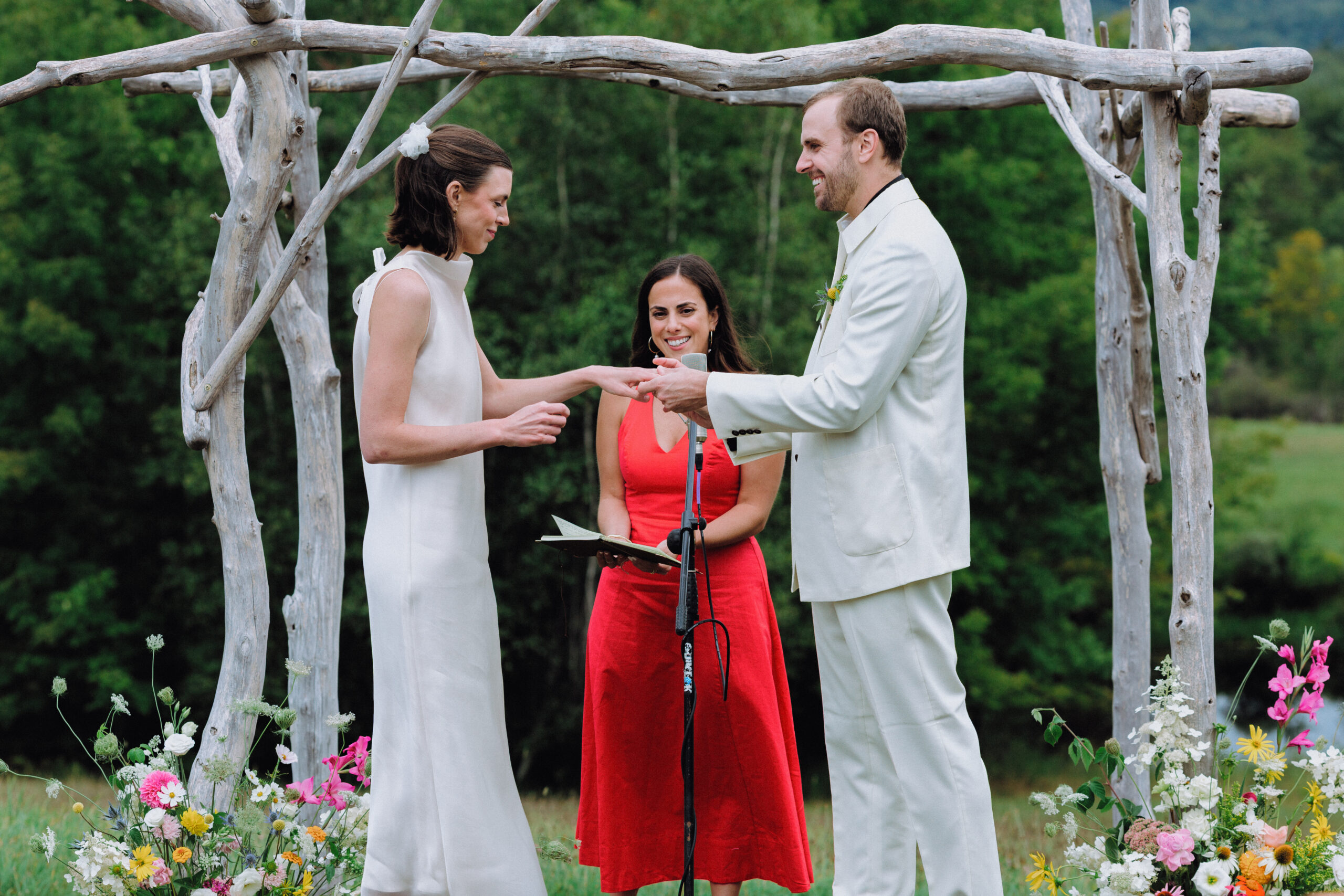
As long as your officiant is legally authorized and you both consent to the marriage in the presence of the officiant, your marriage is valid.
Witnesses Are Not Required
Unlike many states, Vermont does not require witnesses to be present at your ceremony. You can get married with just the two of you and your officiant, and it’s completely legal. So yes, your dog could be the only witness to your wedding.
That said, if you’re having a religious ceremony, check with your officiant to see if your faith tradition requires witnesses.
Step 7: Sign and File the Marriage License
After your ceremony, the marriage license becomes your marriage certificate. Here’s what needs to happen:
You Both Must Sign the License
Before the ceremony, you must both sign the marriage license and deliver it to your officiant. The officiant cannot legally perform the ceremony without the signed license in hand.
Assign someone to be responsible for this. Whether it’s your planner, a family member, or your maid of honor, make sure the marriage license gets to your officiant before the ceremony starts.
We keep our couples’ licenses in a fireproof folder and hand them to the officiant 15 minutes before the processional. It’s that important.
The Officiant Completes and Signs the Certificate
After the ceremony, your officiant will:
- Fill in the date and location of the ceremony
- Provide their officiant information
- Sign the license
At this point, the license officially becomes your marriage certificate.
The Officiant Must File the Certificate Within 10 Days
Your officiant is legally required to return the completed marriage certificate to the town clerk’s office where the license was issued within 10 days of your ceremony.
This is critical. If your officiant doesn’t file the certificate, your marriage is not legally registered. You won’t be able to get certified copies. You won’t be able to change your name. You won’t have legal spousal rights.
Make sure your officiant knows this. Professional officiants and clergy do this all the time. Friends serving as temporary officiants often don’t realize how important the filing deadline is.
Confirm with your officiant, multiple times if necessary, that they know where to send the certificate and will do it within 10 days.
If Your Officiant is a Temporary Officiant
If your friend or family member registered with the Secretary of State as a temporary officiant, they must attach a copy of their authorization certificate to the signed marriage certificate when they return it to the town clerk.
Step 8: Get Your Certified Marriage Certificate
Once your marriage certificate is filed with the town clerk, you can request certified copies.
Option 1: Arrange for Mailing at the Time of License Purchase
When you buy your marriage license, you can pay an additional $10 and arrange for the town clerk to mail you a certified copy as soon as your marriage is recorded.
Total cost: $80 (license) + $10 (certified copy) = $90.
This is the easiest option. You don’t have to remember to request it later and it just shows up in the mail 2-3 weeks after your wedding.
Option 2: Request from the Town Clerk After the Wedding
Two weeks or more after your ceremony, you can request certified copies from the town clerk’s office where you purchased your license.
Cost: $10 per certified copy.
You can request in person or in writing.
Option 3: Request from the Vermont Department of Health
Six or more weeks after your ceremony, you can request certified copies from the Vermont Department of Health, Vital Records Office.
Cost: $10 per certified copy.
Contact: 802-863-7275 or 800-439-5008, or visit HealthVermont.gov.
Why You Need Certified Copies
You’ll need certified copies of your marriage certificate to:
- Change your name on your Social Security card
- Update your driver’s license
- Change your name on your passport
- Update insurance policies, bank accounts, and other legal documents
Order multiple copies. You’ll need them, and it’s easier to order 3-5 at once than to go back later.

Common Mistakes to Avoid
Not Bringing Enough Information to the Clerk’s Office
If you don’t know your parents’ full names (including your mother’s birth name) or their places of birth, the clerk can’t issue your license. Bring your birth certificates. It makes everything easier.
Applying Too Early or Too Late
Your license is valid for 60 days. Don’t apply in May for a September wedding. But also don’t apply the week before your wedding and risk something going wrong. Apply 2-4 weeks in advance.
Assuming Your Friend Can Officiate Without Registration
If you want a friend or family member to officiate, they must register with the Vermont Secretary of State as a temporary officiant and pay the $100 fee. This isn’t optional. Without that registration, they cannot legally marry you.
Forgetting to Bring the Marriage License to the Ceremony
Your officiant cannot perform the ceremony without the physical marriage license. Assign someone to be responsible for bringing it to the venue.
Not Confirming Your Officiant Will File the Certificate
Your officiant has 10 days to file the signed certificate with the town clerk. Confirm they know where to send it and will do it on time. We’ve seen too many couples discover months later that their marriage was never officially recorded.
Final Thoughts: Vermont Makes This Easy, But You Still Have to Do It Right
Vermont is one of the most straightforward states for getting married. No waiting period. No blood tests. Flexible officiant options. But easy doesn’t mean automatic.
You still need to apply for your license, confirm your officiant is legally authorized, sign the paperwork, and make sure it gets filed within 10 days.
If you’re feeling overwhelmed, hire a planner. We walk our couples through the entire process, remind them when to apply, confirm officiant credentials, hold the marriage license on the wedding day, and follow up to make sure it’s filed properly.
Your ceremony can be as creative and personalized as you want. But the legal part? That has to be done right.
Whether you’re just starting to plan or you’re six weeks out and need someone to pull it all together, we can help. Let’s Work Together
Quick Reference Checklist
- [ ] Apply for marriage license 2-4 weeks before wedding at any Vermont town clerk
- [ ] Bring $80 (cash or check depending on clerk’s office)
- [ ] Bring birth certificates (helpful for parents’ information)
- [ ] Provide information about previous marriages/civil unions if applicable
- [ ] If using a friend/family officiant, have them register as temporary officiant with Vermont Secretary of State ($100 fee)
- [ ] Both parties sign marriage license before ceremony
- [ ] Assign someone to bring marriage license to ceremony
- [ ] Ensure officiant files signed certificate with town clerk within 10 days
- [ ] Order certified copies of marriage certificate ($10 each)
- [ ] Use certified copies to update Social Security card, driver’s license, passport, etc.
April 14, 2026
Assorted Artistries
journal